Family Court Guide

The Family Court Process

Entering the court system when self representing can feel overwhelming, especially when the legal language and procedures are designed for trained professionals, who don't always listen to women's voices or lived experiences. This page will walk you through what happens once your application is submitted to court and who the key people are in the courts making the decisions about your children.

Our aim is to help you feel more prepared and confident, so you will see signposts to 'Next Steps' at the bottom of the page to help you continue on your court journey. The time between starting and ending your court journey can vary greatly, some cases are quickly resolved if there's agreement between you and your ex partner, while others can take months or longer if there are issues that aren't agreed on or that require extensive evidence.

Interactive guide

Your journey through the family court, stage by stage

Click each stage to see what happens, when, and how to prepare.

Lots of courts also experience delays due to the volume of applications going through their systems. Court clerks, the gatekeeping teams, CAFCASS and judges are working to their best ability to process each application and ensure that it is treated with the respect and dignity it deserves. Most documents will state a clear timeframe in which the court, parties and other services e.g. social services will have to respond so you have a clear timeline for your case.

How do courts decide how and by whom my case is heard?

How the Family Court decides who hears your case

Once your application is submitted to court, the court decides which level of judge should hear your case before your first hearing.

  1. Application received — the court processes your application.
  2. Gatekeeping — a court legal adviser and district judge (the gatekeeping team) review your application and decide which level of judge should hear your case.
  3. Case allocated — a magistrate for many private law children cases, a district judge for more complex issues, and circuit or High Court judges for the most serious matters.

Hierarchy of judges in the Family Court

  1. Magistrates (Family Panel)
  2. District Judges
  3. Circuit Judges
  4. High Court Judges

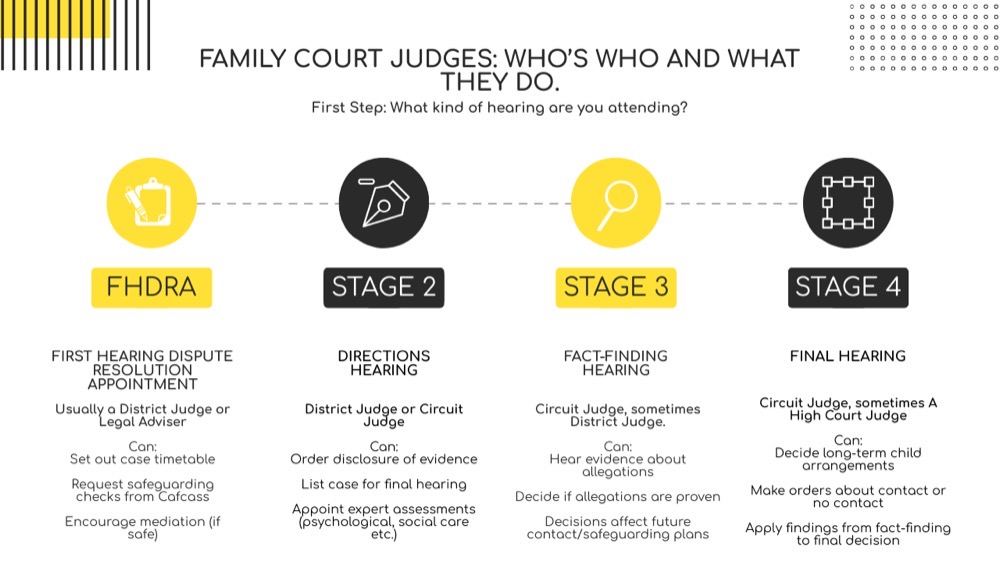
Learn more about each type of hearing.

The Judges

What magistrates in the Family Court can and cannot do

CAN

  • hear many family cases, often private-law children cases on contact and residence under the Children Act 1989
  • make Child Arrangements Orders
  • issue certain protective orders such as Non-Molestation Orders
  • approve consent orders if both parties agree

CANNOT

  • grant a divorce
  • make final rulings in complex financial cases
  • set legal precedents
  • overrule higher judges — their decisions can be appealed to District, Circuit or High Court judges

What District Judges in the Family Court can and cannot do

CAN

  • hear most family cases including most applications under the Children Act 1989
  • make final orders in financial disputes
  • preside over fact-finding hearings where domestic abuse or other allegations are made
  • issue protective orders (Non-Molestation, Occupation and Forced Marriage Protection Orders)
  • enforce existing orders

CANNOT

  • overrule Circuit Judges
  • grant a divorce decree
  • personally investigate allegations (Cafcass and experts provide independent reports)
  • set binding precedents
  • deal with international/cross-jurisdiction cases

What Circuit Judges in the Family Court can and cannot do

CAN

  • handle complex cases including serious welfare or abuse concerns and international disputes
  • conduct fact-finding hearings
  • hear appeals against magistrates' or District Judges' decisions
  • deal with serious public-law child-protection and care cases under the Children Act 1989
  • occasionally set precedents

CANNOT

  • overturn the Court of Appeal
  • deal with the divorce itself (though they handle linked financial and children matters)
  • hear appeals from High Court Judges
  • return children to abusive parents where the child is still at risk

What High Court Judges in the Family Court can and cannot do

CAN

  • hear the most complex family cases
  • make complex long-term arrangements
  • award substantial financial remedies
  • handle international disputes
  • create case law

CANNOT

  • handle every family case
  • settle every finance case
  • take over lower-court cases
  • hear every appeal
  • overrule the Court of Appeal

In the Family Court, each type of judge has different roles, powers and levels of experience. You may first encounter a Magistrate, they are trained volunteers who handle many private law children cases or a District Judge who deals with more complex issues. More serious cases (involving complex safeguarding issues for example) may go to a Circuit Judge, while the most complex and sensitive cases are heard by a High Court Judge.

Next Steps

1

Reflect on your situation

Where are you in your court journey? Are you preparing for court, responding to your ex-partner's application or already waiting for a hearing? Or are you deciding to leave your relationship?

You might find it useful to use one of our flowcharts to help you decide the right steps for you based on your current situation.

2

Do you need more support?

Consider whether you feel confident to self-represent or need further support, such as hybrid representation. You can check out our 'Do I Need a Lawyer?' section for further guidance.

If safeguarding issues such as domestic abuse or domestic violence are a factor in your case, you can access our 'Specialist Services' page .

3

Prepare for the next stage

Gather evidence you may need for your case, such as GP records, school reports, an evidence log of your child(ren's) behaviours or your ex-partners messages. If you need help visit our 'Preparing Evidence' page.

If you're ready, our 'Preparing Court Forms' page guides you through the main types of family court forms.

Quick reference

Glossary of court terms

Court Order
a legally binding decision made by the judge
Parties
the people involved in a case, such as the parents
Trial Bundle
relevant court documents collected in one place
Applicant
the person applying to the court
Rules of Evidence
the rules on what information can be presented at court
Cafcass
social workers who assess children's safety and welfare for the court
Safeguarding
protecting a child's welfare from risk of harm
Judgement
the court's final decision at the end of a case
Service
sending documents to a party in a case
Schedule
the dates and times the court meets about the case
Barrister
a specialist lawyer who presents your case at hearings
Statement
a written account of events and facts presented to the court

Support, if you want it

Prefer hands-on, fixed-fee help preparing this? Phoenix offers administrative and McKenzie Friend support — support, not legal advice — while you stay in control of your case.