

Family Court Guide
Preparing Court Forms
IMPORTANT NOTICE:
Before filing a court application in Family Court, it is a legal requirement to attend a MIAM (Mediation Information Assessment Meeting) with a trained mediator who will give you a certificate to say that you have attended the meeting. You can attend a MIAM either in person or online. You do not have to go through with mediation and your ex partner does not have to attend the MIAM for you to be able to get your certificate.
A MIAM is a meeting with an authorised family mediation to find out more about:
- mediation
mediation
- other options to resolve your dispute without needing to go to court
other options to resolve your dispute without needing to go to court
There are special exceptions set out by the Family Procedure Rules 2010 (Part 3) and Practice Direction (3A, Sections 13–20) for not having to attend a MIAM, which you will tick on your C100 form and can be found on the government's website:
- MIAM exemptions
MIAM exemptions
Below you will find guidance and resources to support you through how to fill out key court forms needed for Family Court. If you need support filing forms regarding Divorce, Finance or Housing, we will signpost you to the relevant service below.
Checklist
Evidence
Gather Your Evidence
A diary of incidents, including dates, times, behaviours from ex partner and children.
Supporting documents such as GP notes, school records, police reports, texts and emails.
Is my evidence safe and secure?
Safeguarding
Are there any safeguarding issues you need to let the court know about?
Safeguarding issues can be related to domestic abuse or violence towards you and your child(ren)
Do I have the contact details of a support service e.g. RISE Sussex, Women’s Aid, National Domestic Abuse Helpline in case I feel unsafe during the process?
Support
Take a moment to check in
Would a friend or McKenzie Friend help here?
Do I need advice from a clinics e.g. Brighton University Clinic, CLOCK or FLOWS?
Do I need emotional support during this process from a support service?
Family Court Orders: Checklist
Purpose
Decides where a child lives, contact arrangements, schooling decisions and holiday arrangements
Prohibited Steps Order
Prevents the other parent from taking a specific action e.g removing child from school/country.
Specific Issue Order
Decides a specific matter such as medical treatment, school, religion or name change.
Form(s) needed:
C100
Main application form for all court orders
C1A
If there are safeguarding or domestic abuse issues
C8
Confidentiality form if you want to keep your address private
Evidence to gather, if relevant:
Any written agreement attempts e.g. emails, texts, parenting plan
School reports e.g. attendance, safeguarding concerns
GP/health visitor notes if child’s health is impacted
Police reports or social services records
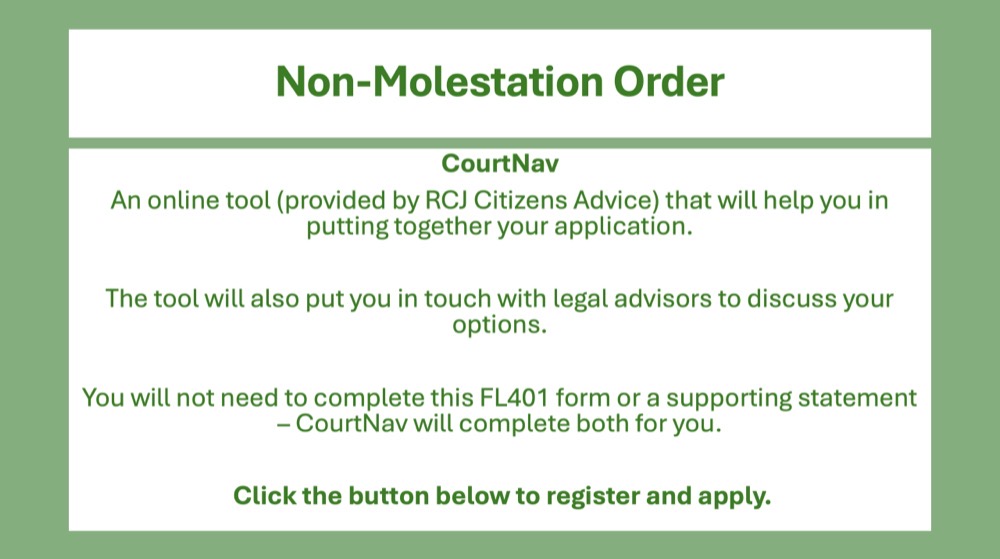
Non Molestation Order
Protects against harassment, threats, abuse or coercive behaviour
FL401
Application form
Evidence to gather:
Police reports or crime reference numbers
GP or hospital notes recording injuries/abuse
Witness statements from friends, neighbours and professionals
Texts, emails, or recordings showing abusive behaviour
Occupation Order
Decides who lives or can enter the family home
Tenancy agreement or mortgage documents
Utility bills to show occupancy
Police reports if relevant
Evidence of risk of harm if you remain in the home e.g. medical/social services reports
Individual Requirements
Provide a general description of the items below and introduce the services you offer. Click on the text box to edit the content.
Domestic Abuse Victims
As part of efforts to make the family court system safer for domestic abuse victims, the court now has clear protection measures for victims during proceedings:
No cross-examination by the abuser
Special measures to ensure your safety and dignity during the proceedings including giving evidence from behind a screen or via video link.
If you are worried about being cross-examined or feel unsafe, you may be eligible for legal aid, depending on your circumstances.
You can ask for these on your C100 form.
Getting help when English isn’t your first language can feel very overwhelming.
You have the right to request an interpreter if English is not your first language. If you have difficulty with written English, courts can arrange translations of core documents.
The court must ensure you can understand, respond, and present your case
You can request an interpreter when making your application on the C100 form.
Your right to an interpreter
Reasonable Adjustments
Court Form Guides
The C100
A Prohibited Steps Order and a Specific Issue Order are applied for using the same C100 form.
The C1A
Further Services
Housing Support
Financial Support
Divorce Support
Support, if you want it
Prefer hands-on, fixed-fee help preparing this? Phoenix offers administrative and McKenzie Friend support — support, not legal advice — while you stay in control of your case.